7 January 2023 · HOLZ-BARAN GmbH
Remarkable wood with versatile uses: ash
The ash, native to Europe, not only yields wood with outstanding properties but also boasts an extraordinary history. Many peoples attach a very special significance to it and value both the ash’s foliage, its fruit clusters and its bark. Read on to discover what makes these trees so fascinating and sets them apart from other species:
The ash — a tree steeped in myth
Even among the ancient Germanic peoples, the ash held an elevated status. As the world tree Yggdrasil, it formed the centre of the universe and connected heaven with the earth and the underworld. Ship fittings made from its wood were said to protect the crew from drowning and to ward off all manner of misfortune at sea. The bark of ash trees was also believed to have many powers: laid on wounds, it staunched bleeding; sewn into clothing, it repelled snake bites. Modern dendrology confirms these insights, attributing the haemostatic and antitoxic effects to the ash’s high tannin content.
But even a single leaf was thought by ancient peoples to work wonders. The Scots used the tree’s foliage as a mediator in disputes — which is why they hung it in bunches in their bedchambers. Even the scientifically minded Romans believed in the power of the ash: in its fruit stage it was regarded as a symbol of a happy marriage; with advancing age, as a guarantor of the endurance of the bond.
The ash — a tree with different meanings
Given these accomplishments, it is surprising that the ash leads something of a shadowy existence among tree species. Unlike the lime or the oak, it has barely made its way into literature or poetry. This can be attributed to the fact that a large part of the former population fell victim to forest fires or was destroyed by slash-and-burn clearance. Particularly during antiquity and through the Middle Ages, the ash had to give way to the demand for fertile, arable soil.
In old place and family names, however, it is reflected just as frequently as other native trees. Designations such as Eschental or Eschenbach also make clear where these plants were mainly to be found: in river floodplains and along the banks of streams. Here the ash contributed to the safety of surrounding inhabitants through its special root network — because it prevented embankments from slipping and stopped flooding. Moreover, the ash shed its leaves year after year, their rapid decomposition enriching the humus content of the soil.
A brief guide to the tree: ash as a living plant…
…with a wide distribution
On the other hand, the ash has always demonstrated a remarkable adaptability. Although it prefers fresh to moist soil with a high mineral content, it also grows in some areas on dry, calcareous soils and colonises surprisingly elevated locations. The distribution range of these trees extends from Scotland to the Iberian Peninsula and the Balkan regions. In German-speaking territories they occur as mountain plants in the Bavarian and Allgäu Alps, where individual specimens reach tree sites at altitudes of 1,000 to 1,400 metres.
…with a distinctive appearance
Especially in the company of conifers, the trees frequently stand in small groups. Their predominantly straight, cylindrical trunks grow up to 40 m tall and are generally branch-free in their lower third. The diameter is 50–80 cm. Although the ash is a tree that can live up to 250 years, only a few specimens reach the maximum possible age — partly because they are felled as timber between their 80th and 120th year, and partly because the light requirements of mature trees change and no longer match the conditions at their location.
…in numerous varieties
In addition to the so-called common or European ash, numerous further varieties exist worldwide. Examples include
- the flowering ash, native to China
- the velvet ash, originating from Japan
- the Arizona ash, from southern California and New Mexico
- the white ash, widespread in North America, and
- the decorative weeping ash
Each has its own requirements for living conditions and produces wood of differing appearance.
…for fodder storage
Both at high altitudes and in valley locations, the plants served primarily as animal fodder. Not only wildlife fed on the buds, foliage and bark of the ash: the young leaves in particular were a sought-after feed source for livestock. For this purpose, keepers would detach the branches from the trunk shortly after they came into leaf, let them dry and store them as hay for the winter. This practice also contributed in part to the gradual reduction of ash populations.
…under serious threat
Since the early 1990s the trees have also been threatened by fungal infection. Starting from Polish territory, increasing numbers of specimens became infected with Hymenoscyphus fraxineus, the ash dieback fungus. This sac fungus lives parasitically and damages the ash by colonising its leaf tissue, vascular system and pith. By now not only the trees of the Baltic states are affected, but also larger populations in northern, north-western and central Europe. For some time the effects of the fungal infection have been impossible to overlook in Germany, Austria and Switzerland as well: here, as elsewhere, the trees are losing their foliage and visibly withering. Yellowish-brown to reddish-brown deposits appear on their bark.
The ash as a timber supplier…
…with declining demand
A further reason why ash is today among the less commonly used tree species is the sharp decline in demand. While its wood found countless applications in previous centuries, it is now considerably less sought after. In the trades of coach-making, turning and coopering in particular, the material has lost much of its former significance — because these occupations have either lost their original relevance or undergone a complete reinterpretation.
…for furniture making
But even in seemingly timeless industries such as furniture making, demand for ash has fallen. Responsible for this is the variable colour of its heartwood: depending on the location of the growing trees, it develops either a pale or a brown to deep brown tone. The darker shades no longer suit current interior trends — which is why, for the time being, only enthusiasts purchase classic ash furnishings.
…with numerous advantages
For other industries, however, ash provides a material that meets many of the timber industry’s requirements: it can be worked both manually and by machine, is as flexible as it is load-bearing and exhibits only slight shrinkage. Because the trees come from domestic forests, they guarantee short transport and processing routes, so that ash wood also meets the requirements of environmental protection and economic efficiency.
Ash as a building material
…for sporting and working equipment
It finds an important use in the manufacture of sporting equipment. In particular, the producers of parallel bars and bows; but also the manufacturers of oars and javelins as well as of skis and sledges rely on the high elasticity of ash. In addition, the wood is used for snooker cues and for the handles of striking or splitting tools and garden implements.
…for musical instruments
Since steamed ash bends well, the wood also serves in the construction of musical instruments. Different species are used to meet different requirements. The tonal properties of the European varieties are sufficient for acoustic guitars and drum shells; for electrically amplified instruments, instrument makers prefer to buy North American swamp ash.
…for wooden floors and staircases
Ash proves its literally load-bearing quality as wood for staircases, handrails and balustrades, and as material for parquet, planks and other floor finishes. In this field the ash once again excels through high elasticity, as well as through above-average abrasion resistance and its resilience against weak acids or alkalis.
Ash as a floor covering
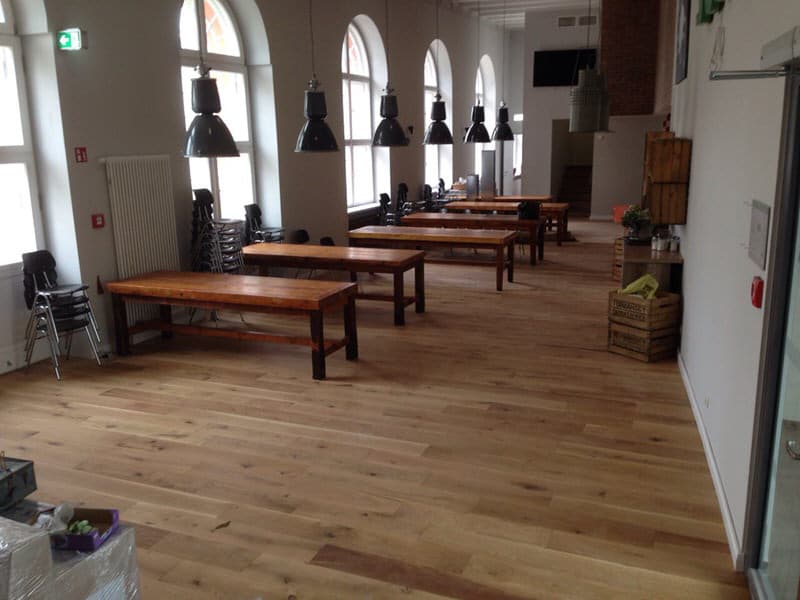
The advantages mentioned make the wood an ideal floor material for living and bedroom spaces. Because it is so hard and resilient, even heavy furniture and sculptures or frequent foot traffic leave barely a mark. At the same time, wooden floors made of ash have a silky-smooth surface that is pleasant even for bare feet.
A further advantage of ash wood is that it has a temperature-balancing effect. Depending on the season, it warms or cools the room, thereby achieving effects similar to those of air conditioning. However, it tends towards increased gap formation in dry conditions, so that a humidifier is recommended when relative humidity falls below 40%. For installation over underfloor heating, experts advise two-layer material.
But ash also has its own requirements regarding the effects of moisture: the wood can only be impregnated to a limited extent and is therefore very sensitive to the effects of the weather. For this reason it is installed exclusively indoors. For cleaning wooden floors made of ash, moderately damp, soft cloths should be used to avoid moisture damage and scratches.
Ash at HOLZ-BARAN: advice and tips included
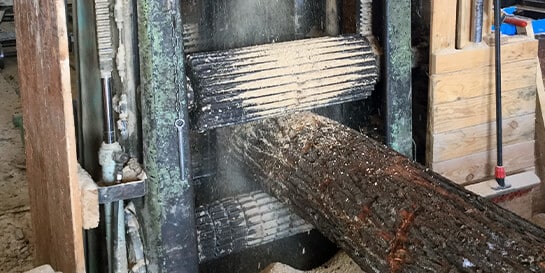
When manufacturing wooden floors from ash, we make use of regional sources. Processing takes place in our own sawmill near Leipzig, so you can be certain of receiving products that have been monitored throughout. Due to numerous enquiries, we offer interested parties appropriate consultation on this topic. For information on the origin, delivery, storage and further processing of raw ash, our trained staff are available Monday to Friday between 7:00 and 16:30.
We are also happy to answer questions about the visual effect of our wooden floors. We have created a collection with its own individual character for every conceivable interior style, which further underlines the natural beauty of the wood used. Choose your future plank floor from six different finishing options and find the relevant information here.